
Why is thermocouple selection an engineering-critical topic?
A thermocouple is one of the most critical field devices that carries temperature information to the control system. A poorly selected thermocouple may cause measurement error, unstable control, unnecessary energy consumption, quality problems and process safety risks. Thermocouple selection is therefore not limited to choosing between K type and J type. Measuring point temperature, atmosphere, mechanical load, response time, cable routing, electrical noise, process connection and maintenance conditions must be evaluated together.
1. Thermocouple type and temperature range
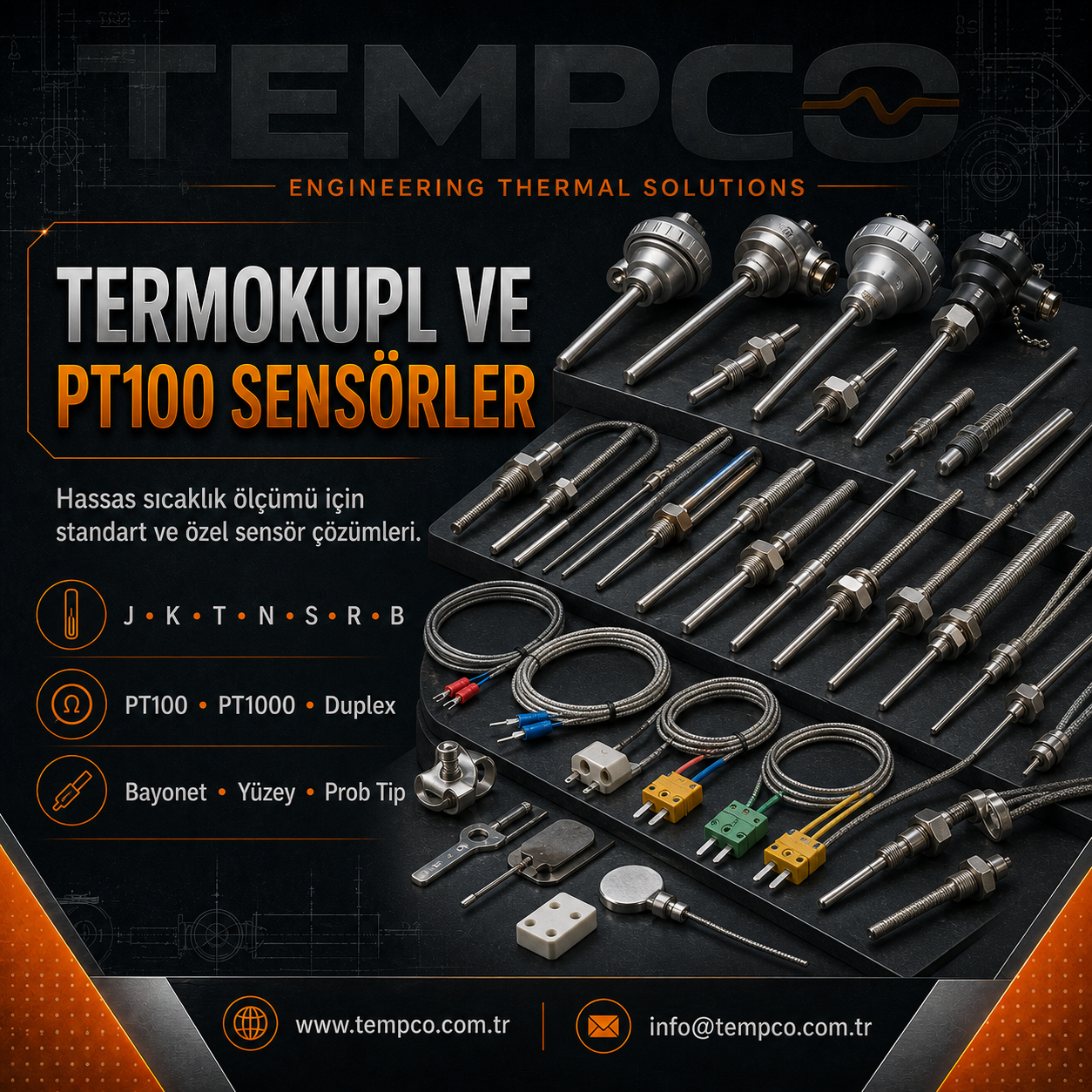
The most common industrial thermocouple types are J, K, T, N, S, R and B. K type thermocouples are widely used due to their broad temperature range and suitability for oxidizing atmospheres. J type is common in medium-temperature applications but moisture and oxidation should be considered. T type is preferred for low-temperature and precise applications, N type for high stability, and S/R/B types for high-temperature furnace and laboratory processes.
2. Junction style: grounded, ungrounded and exposed
The junction style directly affects response time and electrical behavior. A grounded junction provides faster response because it is in contact with the sheath, but it can be more sensitive to electrical noise. An ungrounded junction is isolated from the sheath and provides better electrical isolation. An exposed junction offers very fast response but has limited mechanical and chemical protection.
3. Sheath material selection
Sheath material is one of the key factors that determine sensor life. Stainless steel sheaths are widely used in general processes. SS304 is a general-purpose option, while SS316 offers better corrosion resistance. In high temperature or aggressive atmospheres, Inconel, Incoloy or ceramic protection tubes may be preferred. Furnace applications must be evaluated in terms of oxidation, reduction, thermal shock and mechanical damage.
4. Probe diameter, insertion length and response time
Smaller probe diameters generally improve response time but reduce mechanical strength. Larger probes are more robust but respond more slowly to temperature changes. If the insertion length is not selected properly, the sensor may measure an affected value rather than the representative process temperature. The measuring tip should be placed deep enough in the representative hot zone or flow region.
5. Cable insulation and compensation cable
Thermocouple signals are at millivolt level, so cable selection is important. PVC, silicone, fiberglass, PTFE or metal braided cables should be selected according to ambient temperature, mechanical wear and chemical exposure. Correct compensation cable must be used: K type for K type thermocouples, J type for J type thermocouples, and so on. A wrong cable type can create measurement errors at connection points.
6. Process connection and installation details
Thermocouples can be supplied with threaded fittings, compression fittings, flanges, bayonet connection, surface lugs, magnetic surface types or connection heads. Bayonet thermocouples are common in plastics machinery, while threaded or thermowell-mounted designs are preferred in tanks and pipelines. In vibrating applications, cable exit style, spring loading, protective armor and connection head design are important.
7. Thermowell usage
A thermowell is recommended in pressurized, flowing, abrasive or service-critical applications where the sensor should be replaced without stopping the process. It protects the thermocouple and simplifies maintenance. However, wrong thermowell diameter, length, tip form or material can increase response time or cause mechanical vibration risk.
8. Electrical noise and measurement accuracy
Thermocouple cables should not be routed together with motor drives, contactors, power cables or high-current lines. Signal cables should be separated from power cables as much as possible. Shielded cable and correct grounding strategy can improve signal stability. The controller, transmitter or PLC input must be compatible with the selected thermocouple type and cold junction compensation must be set correctly.
9. Data required for quotation
- Thermocouple type: J, K, T, N, S, R, B
- Operating and maximum temperature
- Probe diameter, insertion length and total length
- Sheath material and process atmosphere
- Junction style: grounded, ungrounded or exposed
- Cable insulation, cable length and connector type
- Process connection: fitting, flange, bayonet, thermowell etc.
- Connection head, transmitter or accessory requirements
TEMPCO thermocouple solutions
TEMPCO provides technical support for standard and custom thermocouples, PT100/PT1000 sensors, thermowells, compensation cables, connectors and accessories. Production can be based on a sample, technical drawing or completely new sensor design according to process requirements.
Frequently Asked Questions
What are the main criteria for thermocouple selection?
Temperature range, process atmosphere, response time, sheath material, probe diameter, junction style, cable insulation and process connection must be evaluated together.
What is the difference between grounded and ungrounded junctions?
A grounded junction gives faster response, while an ungrounded junction provides better electrical isolation and more stable measurement in noisy environments.
When should a thermowell be used?
A thermowell should be used in pressurized, flowing, corrosive or mechanically demanding processes to protect the sensor and simplify replacement.